




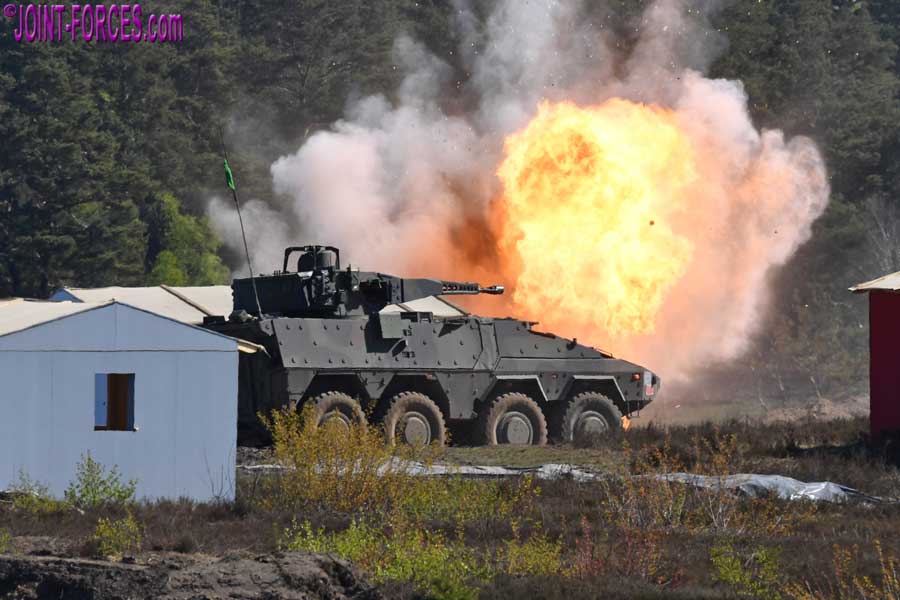
Bundeswehr ‘Wie das Heer kämpfen wird!‘ (WDHKW) or How The German Army Will Fight, demonstration and experimental exercise, by Carl Schulze.
~
The Lehr- und Versuchsübung ‘Wie das Heer kämpfen wird!‘ or WDHKW exercise focused on how the German Army will fight in the future. It provided a glimpse into how modern land forces can operate in the age of digitalisation.
The exercise was based on the German Army’s Campaign Plan Heer 2035+, for which the current security situation in Europe and the way how modern conflicts are fought forms the foundation. In the following two-part feature we will provide readers with a step-by-step overview of the exercise conducted in late April and early May 2026 on Range 3 of the Munster North Training Area.
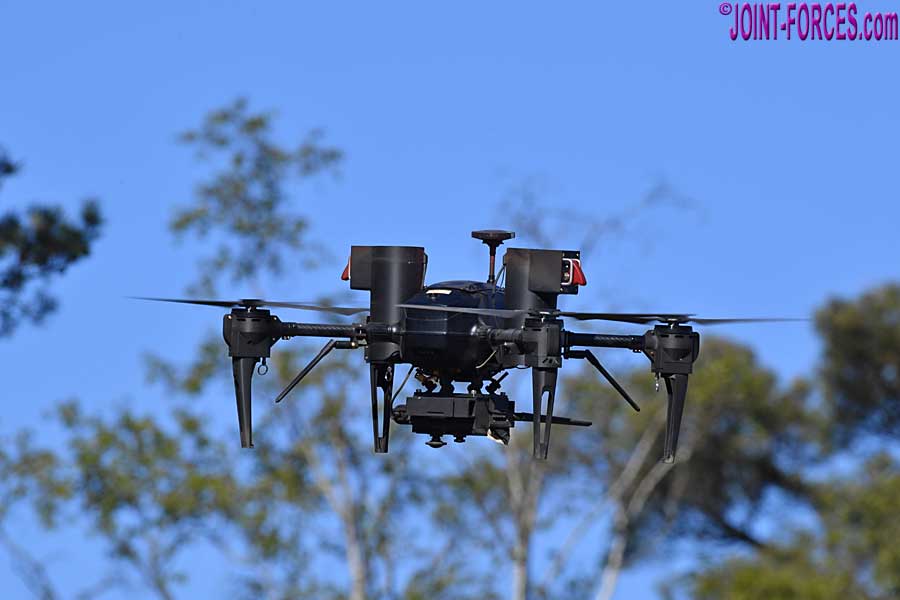
Just as with World War II, and other major conflicts before and after it, the full-scale invasion of Ukraine by Russian armed forces in February 2022 resulted in a speedy development of military technology. In the case of the Russo-Ukrainian War this took place mainly and foremost in the field of unmanned systems; namely Unmanned Aerial Vehicles (UAV), Unmanned Ground Vehicles (UGV) and Unmanned Surface Vessels (USV). As a result of this recent development, today there is a roughly 25km wide zone between the opposing Ukrainian and Russian forces in which unmanned systems operate almost exclusively. Literally no movement can be conducted without being detected by a sensor. Usually within seconds, but at the latest after a couple of minutes, the detected target will be attacked and destroyed by either by indirect fire or UAVs.
This is the type of battlefield for which the scenario of the recent demonstration and exercise conducted by the Panzerlehrbrigade 9 (Armoured Brigade 9) of the German Army, commanded by Brigadier General Stephan Behrenz, was developed.
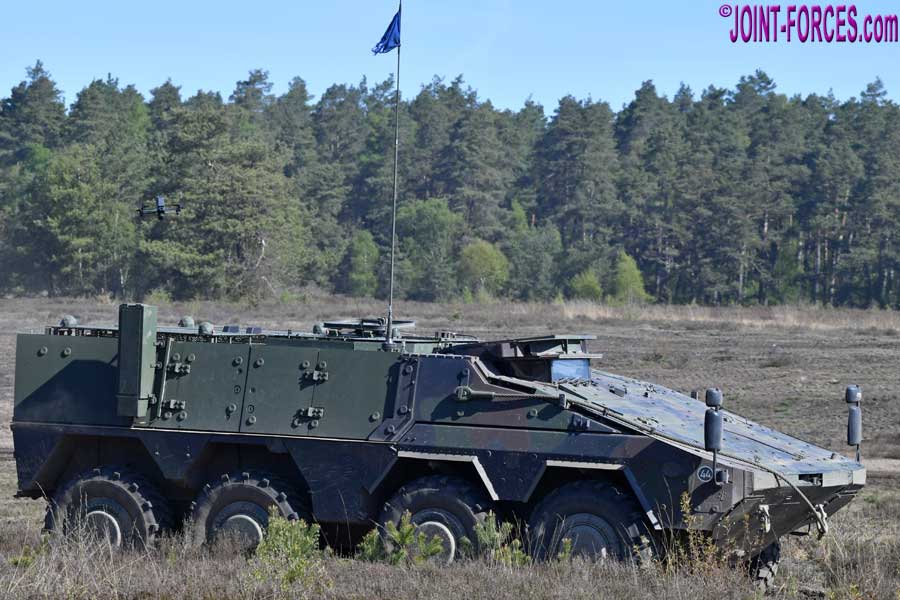
Phase 0: During Phase 0 of the exercise demo visitors were transported in GTK Boxer and Transportpanzer 1 Fuchs wheeled armoured transport vehicles to a grandstand on Range 3 on the Munster North Training Area. En-route to the forward line of own troops (FLOT) the vehicles passed through the corps, division and brigade rear area, where various command, logistic and support elements could be seen; for example a supply point and a maintenance and repair point run by a logistic unit, the mobile command post of the brigade commander of the Panzerlerhbrigade 9, an artillery firing position and deployed short and medium range air defence systems. These assets provide command and control, logistic support, long range indirect fire support and air defence for the combat forces deployed forward.
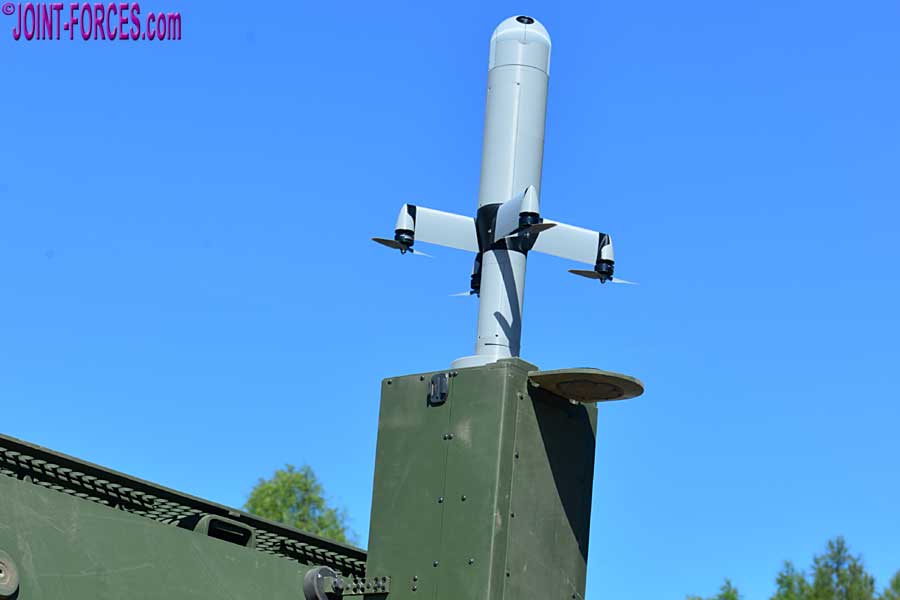
Already in the rear area many unmanned and remote-controlled systems had been fielded. For example, a THeMIS (Tracked Hybrid Modular Infantry System) UGV in cargo carrier configuration was loaded with supplies by a remote-controlled tracked variant of the Palfinger CRAYLER. UAVs and UGVs were also employed to provide security for the various logistic sites. One vehicle employed here was an armed Gereon tracked UGV manufactured by ARX Robotics.
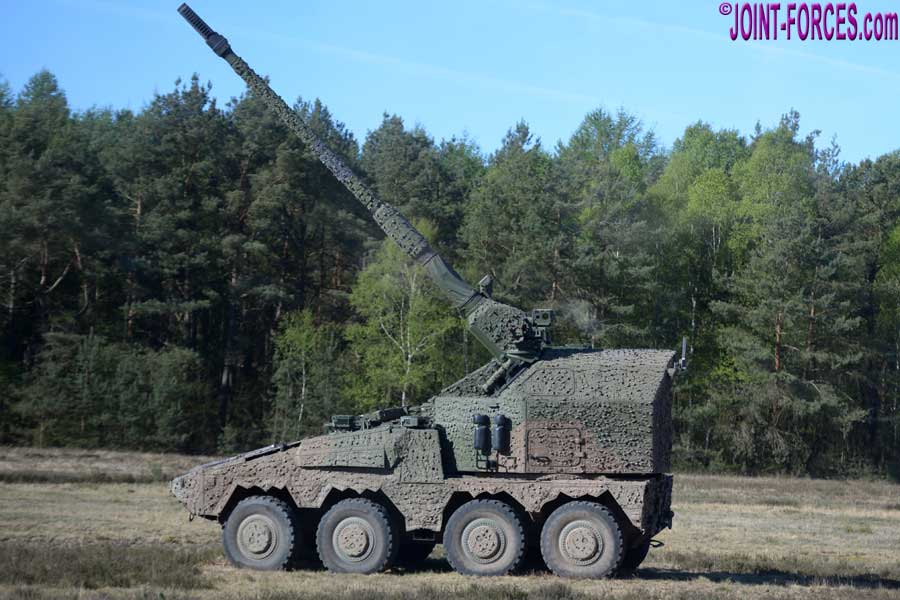
The artillery and air defence systems employed included, among others: a GTK Boxer based RCH 155 or Remote Controlled Howitzer 155mm; a MARS II Mittleres Artillerie-Raketen-System or Multiple Launch Rocket System; Skyranger short range air defence system based on GTK Boxer; and the IRIS-T SLM (Infra Red Imaging System – Tail/Thrust Vector Controlled, Surface Launched Medium Range) air defence system.
Phase 1 – Establishing a Self- Protection Umbrella: After the arrival of the visitors at the grandstand the demonstration started in earnest. Phase 1 of the demo was now focused on the establishment of a multi-layer protection umbrella in a zone where Panzerlerhbrigade 9 planned to fight a delaying battle against advancing enemy armoured forces. For this to become effective the already existing umbrella that protected own forces deployed in staging areas had to be extended forward.
As a result of this, the protection umbrellas of the friendly forces and the enemy forces now began to overlap creating a zone in which the density and omnipresence of sensors could detect any movement or emission in a matter of seconds. UAVs or indirect fire were then employed to neutralise the detected target. Once the protection umbrella was in place, Medium Forces were then deployed to Heidedorf village in order to fight the actual delaying action. At the same time Light Forces deployed to their left and right, providing flank protection.
The deployment of the umbrella, as well as that of the Medium and Light Forces, was supported by the URANOS KI to process the huge amount of data provided by the unmanned and manned reconnaissance assets now employed. Using ground data, the system could even select the best possible firing positions for main weapon systems; these positions were then shown on the Battlefield Management Systems, using SITAWARE software fitted to the combat vehicles.
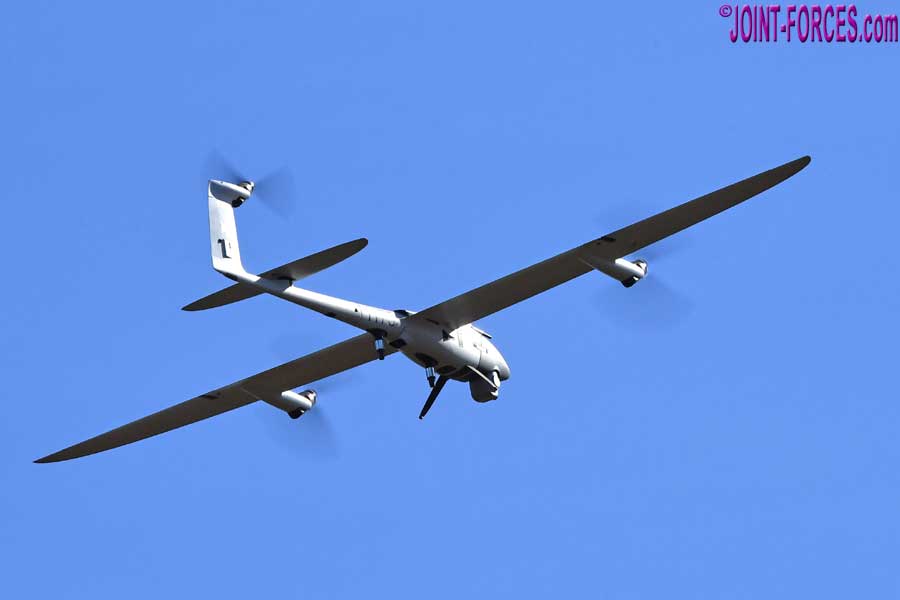
First contacts with the enemy in this phase were made with unmanned systems in order to preserve combat power and shape the battlefield for the deployment of the manned assets. Reconnaissance assets such as FALKE (Ferngeführtes Aufklärungssystem, Luftgestützt, Kurze Entfernung) UAVs were employed initially, followed by swarms of different UAVs to neutralise enemy sensors. UGVs also saw action; for example a Ziesel developed by Diehl Defence, fitted with a MELLS (Mehrrollenfähiges Leichtes Lenkflugkörpersystem) multi-role guided missile system that engaged an enemy main battle tank.
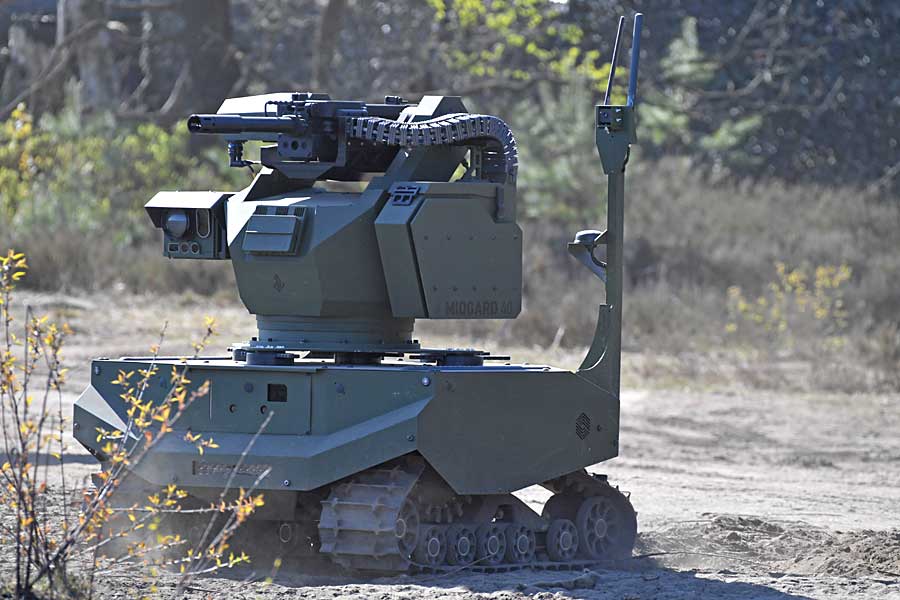
Then the flank protection moved into action. This consisted of manned and unmanned systems, namely: THeMIS UGV manufactured by Milrem Robotics and fitted with a RCWS armed with a 12.7mm M2 heavy machine gun; Gereon tracked UGV, manufactured by ARX Robotics, fitted with a Midgard 40 RCWS armed with a 40mm Grenade Machine Gun or GMG; and Waffenträger Wiesel 1 armament carriers fitted either with a 20mm automatic cannon or MELLS.
With the umbrella and the flank protection in place the Medium Forces now took Heidedorf village. These forces were equipped with a range of different GTK Boxer variants, among them the infantry fire support vehicle fitted with the manned Lance turret armed with the 30mm MK30-2/ABM automatic cannon and the Schakal wheeled armoured infantry fighting vehicle fitted with the same turret, as well as the Puma armoured infantry fighting vehicle. Also employed was a GTK Boxer UAV that served as mothership for Tytan Interceptor UAVs and reconnaissance UAVs. To the rear of the Medium Forces the Boxer-based 30mm Skyranger short range air defence system followed in order to further extend the protection umbrella.
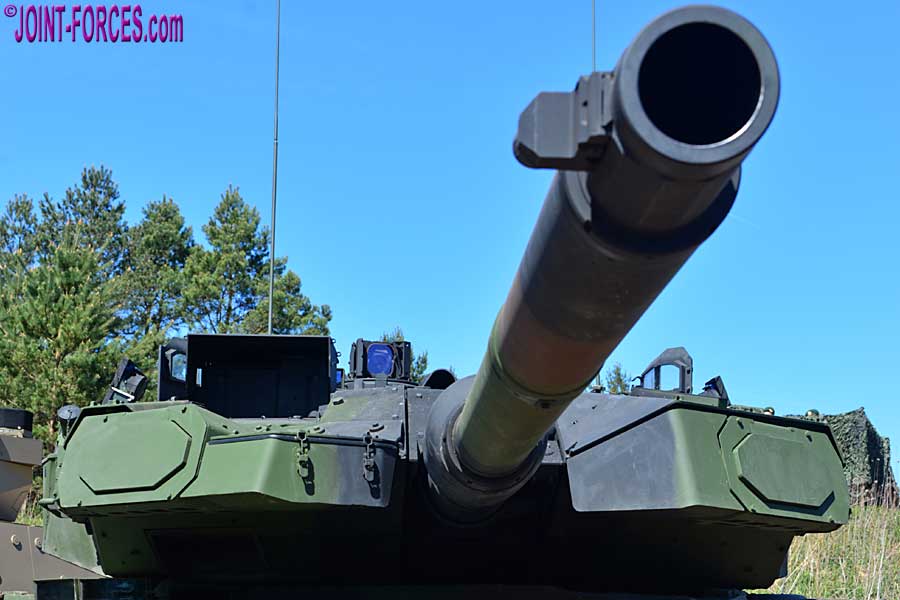
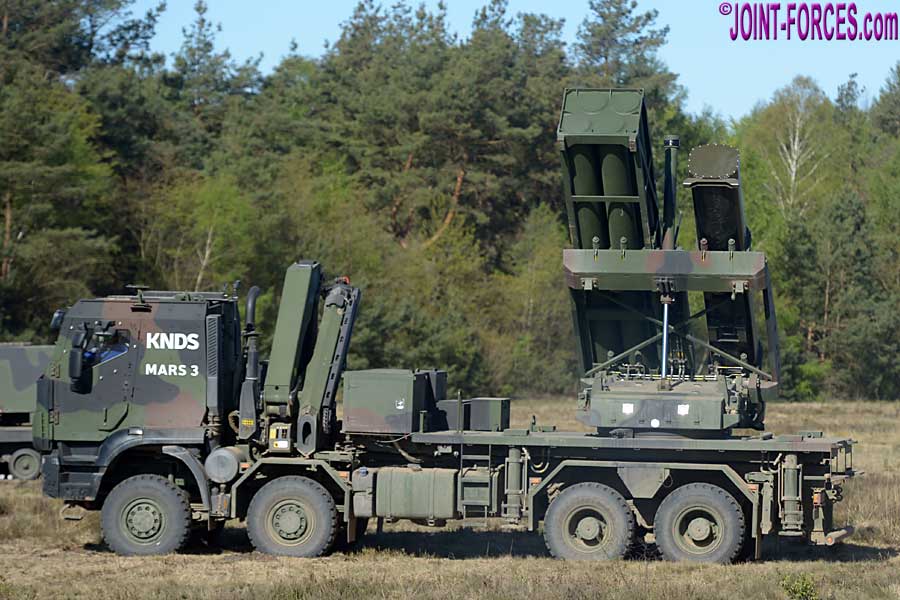
Phase 2 – Fight in the Deep: The area in which the Medium Forces had deployed was still a contested space, covered by both own and enemy protection umbrellas. In order to further weaken the enemy’s umbrella, deep strike assets were now employed to destroy enemy sensors and effectors which have been maintaining the enemy protection umbrella. During the exercise, for this task a MARS II (Mittleres Artillerie-Raketen-System) Multiple Launch Rocket System and a Euro PULS (Precise and Universal Launching System) were deployed to conduct simulated fire missions; Euro PULS will soon enter service with the German Army under the designation MARS 3. Target information for the deep strike assets were generated by a FALKE UAV, which has a penetration range of 60km. Also under this phase the employment of the new Loitering Munition-System (LMS) that will soon enter service with the German Army was simulated. A UAV swarm was also employed and used to target an enemy air defence position and other high value targets. Attacks of enemy UAVs were countered with own UAVs launched by the GTK Boxer UAV. Also employed in the ‘Fight in the Deep’ were Panzerhaubitze 2000 self-propelled howitzers and GTK Boxer based RCH 155 (Remote Controlled Howitzer 155mm)
[images © Carl Schulze 2026]
~
Continued…..
- How The German Army Will Fight ~ Phases One and Two
- How The German Army Will Fight ~ Phases Three and Four

















Pingback : How The German Army Will Fight ~ Phases Three and Four | Joint Forces News