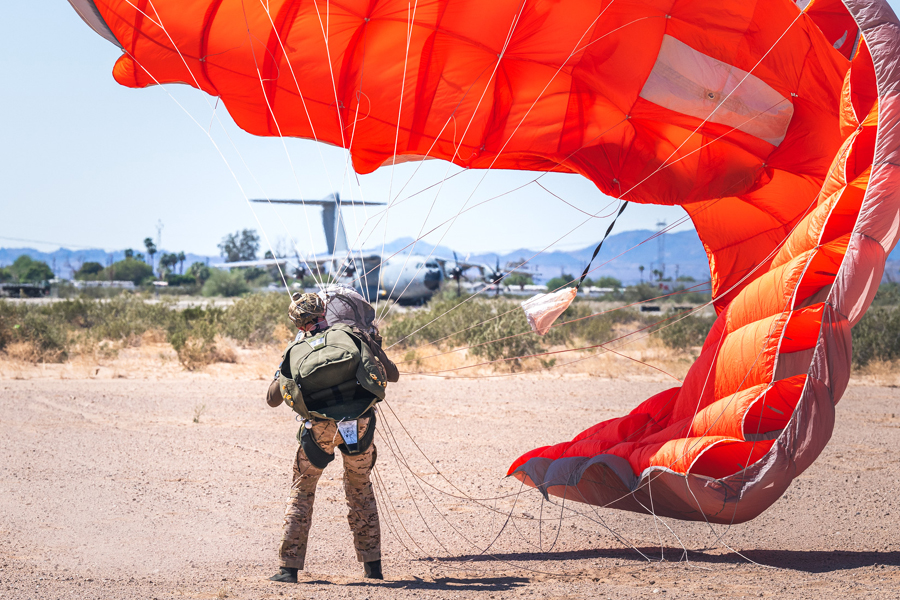
The Belgian Special Operations Regiment has been training in the United States during Exercise TACTICAL AIR INSERTION (TAI) 26.
~
Press Release, Brussels, 10 April 2026: [auto-translated] In the first two weeks of April, the [Belgian] Special Operations Regiment has trained for tactical air insertion and deliveries during the Exercise Tactical Air Insertion (TAI26). California’s sprawling airspace, rugged terrain and heat give Belgian units the opportunity to sharpen their skills. Army and Air Force worked closely together to carry out operations at high and very high altitudes, with the A400M aircraft of the 15th Wing as a crucial link.
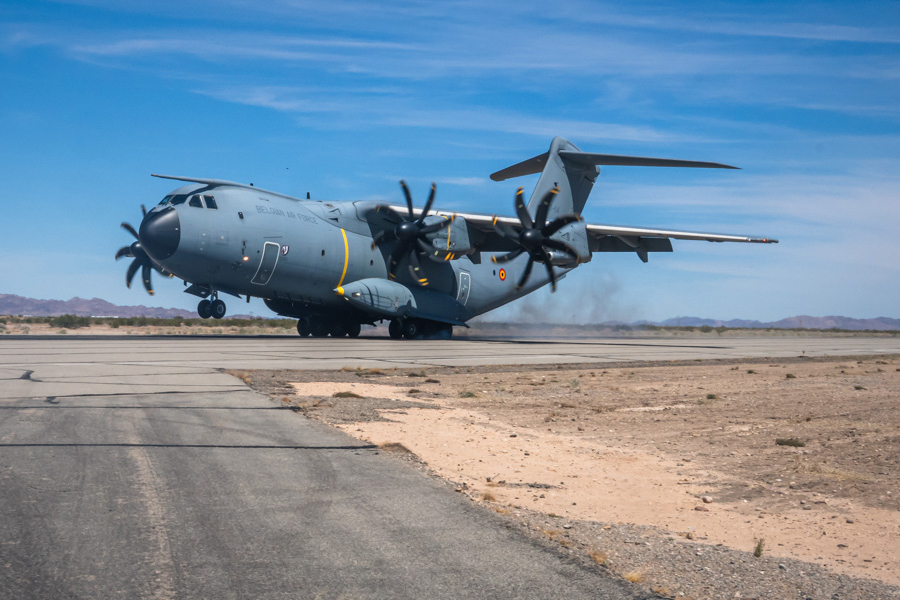
Under a merciless sun and with the California mountains in the background, an A400M rises from Blythe airport. On board are operators of the Special Forces Group, together with Special Reconnaissance teams of the 3rd Paratrooper Battalion and the 2nd Commando Battalion. Their assignment starts in the air, but only ends deep in the terrain, where they carry out the different phases of the tactical operation.
With TAI26, the Special Operations Regiment (SO Regt) trains precisely those capabilities that are essential for its operational deployment. “The goal of Tactical Air Insertion is to train the operators of the Special Forces Group and the Special Reconnaissance capacity of our battalions in jumps at large and very high altitudes,” explains Major Marco, principal manager of the exercise. This is supported by the 14th Medical Battalion, the 6th Group Communication and Information Systems, the Military Police Group, the Movement Control Group, the Meteo Wing, the Training Center for Paratroopers, the RavAir (Ravitaillement par Air) air supply platoon and the 15th Wing Air Transport.
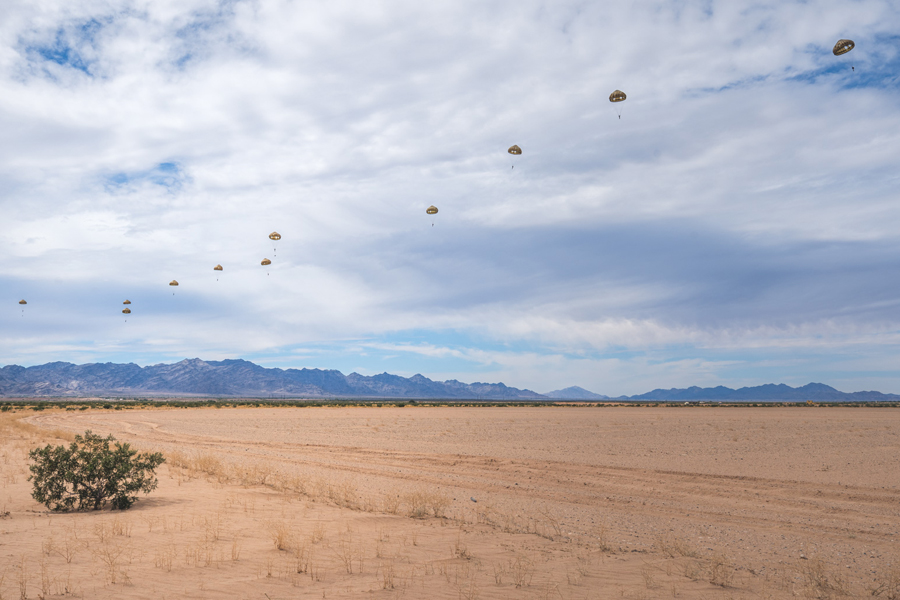
Full Mission Profiles: What sets TAI26 apart from other parachute workouts is the emphasis on the Full Mission Profiles. These realistic simulations of a full mission include all operational phases (preparation, execution, unforeseen circumstances and return).
The parachute jump is only one part of a broader operational exercise. “We prepare the assignments, plan and carry out the jumps and then continue with a tactical scenario. That is very difficult to organise in Belgium, and even in Europe,” Marco explains. The training follows the principle of train as you fight: the operators jump into operational configuration, with their full organic armaments and, at very high altitudes, with oxygen. “The military is heavily loaded and local conditions make it extra challenging.”
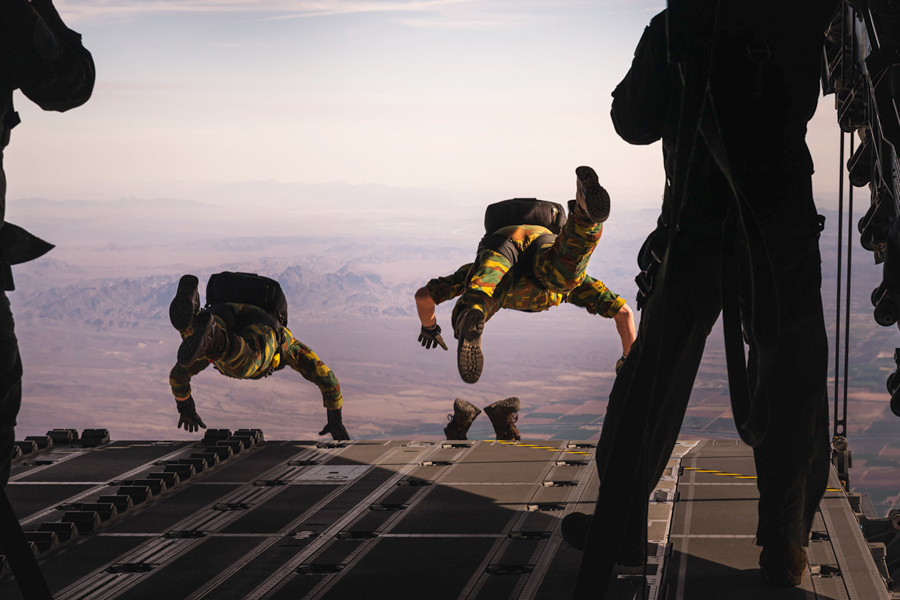
Progressing From The Air: The exercise is progressively constructed. The first phase is aimed at achieving technical qualifications, carried out from a Sherpa aircraft. After that, participants will switch to the A400M, the operational platform of Defense, and then jump and drop material at altitudes between 13,000 and 18,000 feet. Air delivery systems at (very) high altitude of the RavAir platoon make it possible to drop supplies, equipment or ammunition with precision.
After the initial technical phase, TAI26 evolves into fully tactical scenarios. The jump then becomes a means, not an end in itself. “The emphasis is on the preparation of the assignment, the deployment and the subsequent Full Mission Profiles, including shooting exercises, enemy intelligence-based scenarios and the deployment of unmanned aviation systems,” explains Marco. This integration of different capacities provides an important operational added value.
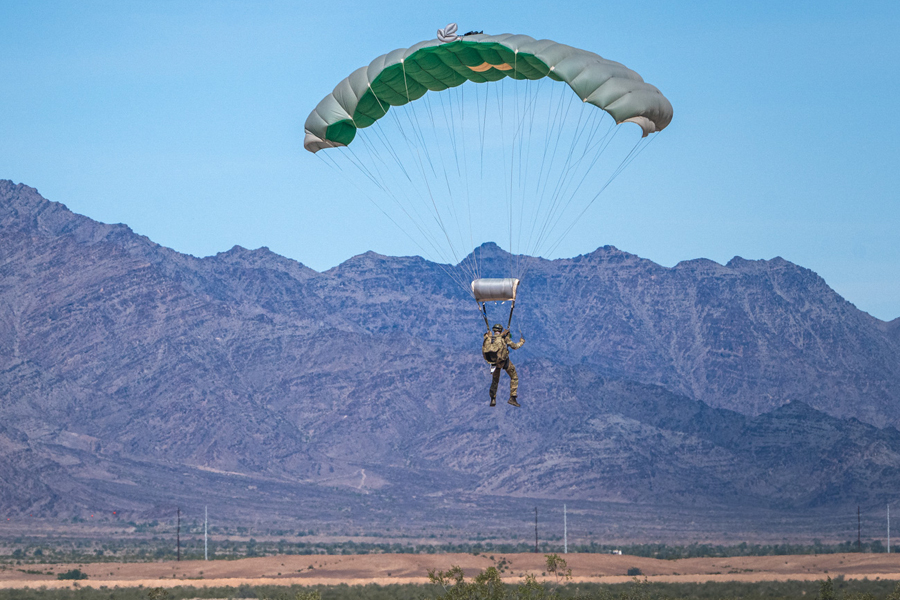
Hand In Hand With The Air Force: The close cooperation with the Air Force, and in particular the 15th Wing Air Transport, is essential. “Our learning goals are almost identical. We benefit from each other’s abilities to achieve our qualifications,” Marco emphasises. This joint approach strengthens interoperability and increases the operational strength of both powers.
The choice of Blythe as a practice location is no coincidence. While European airspace is highly regulated and training is often tied to strict restrictions, California offers the necessary freedom to train complex scenarios. “The climate is ideal and the airspace is enormous, so we can train day and night,” said Marco. “In Belgium or Europe, airspace is very limited. Here we can infiltrate from very high altitudes without hindering civilian air traffic.”
Blythe also offers unique possibilities on the ground. At about 6,000 km², just over twice the surface of Luxembourg, it offers space for navigation, shooting exercises and training with live-firing and explosives. In this way, the participating units can refine their procedures within a coherent and realistic operational framework.
~