

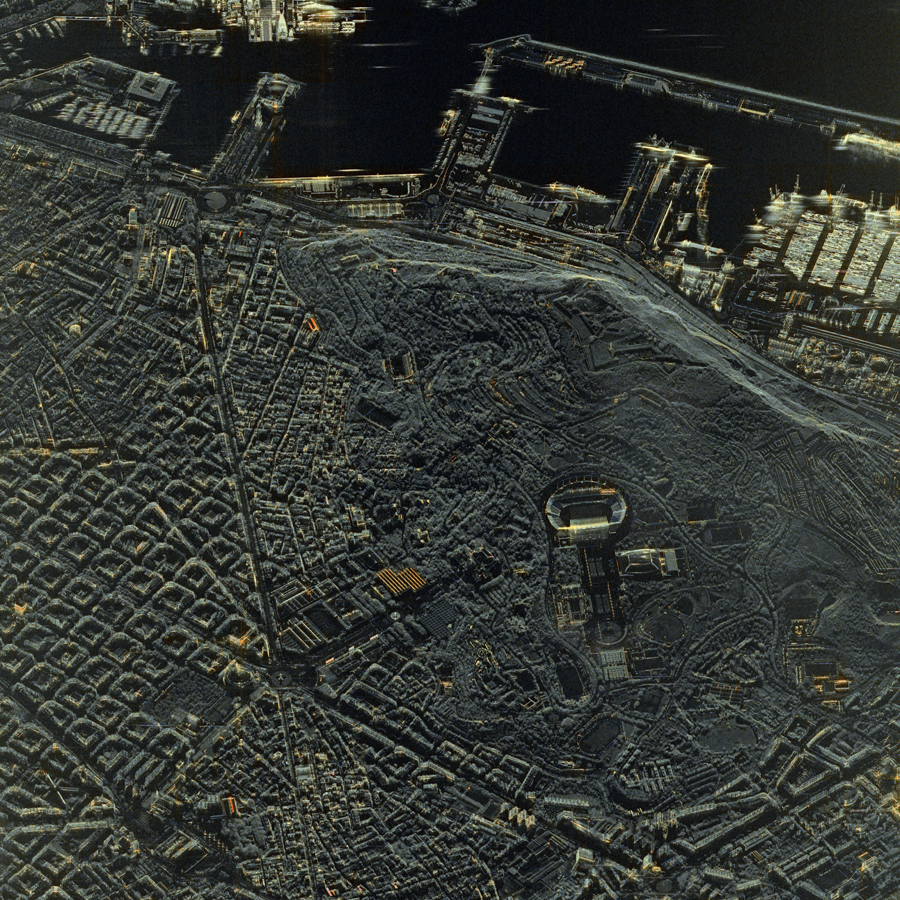
Airbus Defence and Space and Hisdesat have signed an agreement to commercialise imagery from the future PAZ-2 radar satellites.
~
Press Release, Madrid / Brussels, 28 January 2026: Airbus Defence and Space and Hisdesat have agreed to prolong and expand their long-standing and successful collaboration in the international radar Earth observation market with the signing of an agreement to commercialise imagery and applications from the future PAZ-2 radar satellites.
The agreement, formalised during the European Space Conference in Brussels (Belgium), extends the existing partnership for the commercialisation of radar imagery from the PAZ satellite in constellation with the German TerraSAR-X / TanDEM-X satellites, an alliance first established in 2018.
“This partnership aims to push the boundaries of Synthetic Aperture Radar (SAR) based Earth observation and provide innovative solutions to meet growing global demand for both military and commercial markets,” said Eric Even, Head of Space Digital at Airbus Defence and Space.
Miguel Ángel García Primo, CEO of Hisdesat, indicated that reinforcing this commercial alliance “will ensure the continuity of the excellent work carried out since 2018 between the Hisdesat and Airbus teams” and “will drive the penetration of SAR imagery—capable of performing in any weather condition—compared to other Earth observation tools”.
Led by the Spanish Ministry of Defence and Hisdesat, PAZ-2 is one of the most advanced Earth observation programmes in the world. It consists of twin satellites that will replace the current PAZ satellite, in service since 2018, ensuring and enhancing the current capabilities. The PAZ-2 programme is funded by the Spanish Ministry of Industry and Tourism and will provide radar imagery and services primarily to the Spanish Ministry of Defence. In July 2025, Hisdesat awarded Airbus Defence and Space the contract for the manufacture of these two new satellites.
The PAZ-2 satellites are scheduled to fly in constellation and will integrate advanced technologies enabling unprecedented image quality with an improved resolution of up to 10 centimetres. They will also increase coverage to 6.7 million km2 per day per satellite, offering a maximum image swath width of 500 km.
To meet the requirements of urgent operations, the PAZ-2 mission will provide reliable near-real-time services, with a latency from acquisition to availability of only five minutes. These enhancements will strengthen intelligence and surveillance capabilities for defence and security missions, as well as civil applications in infrastructure monitoring, risk management, border control, and disaster assessment. The first of the PAZ-2 satellites is expected to enter service by mid-2031.
This next-generation Earth observation programme consolidates the leadership of the Spanish space industry, with 65% national participation under the direction of Airbus Defence and Space, which serves as the prime contractor for the space segment.
~