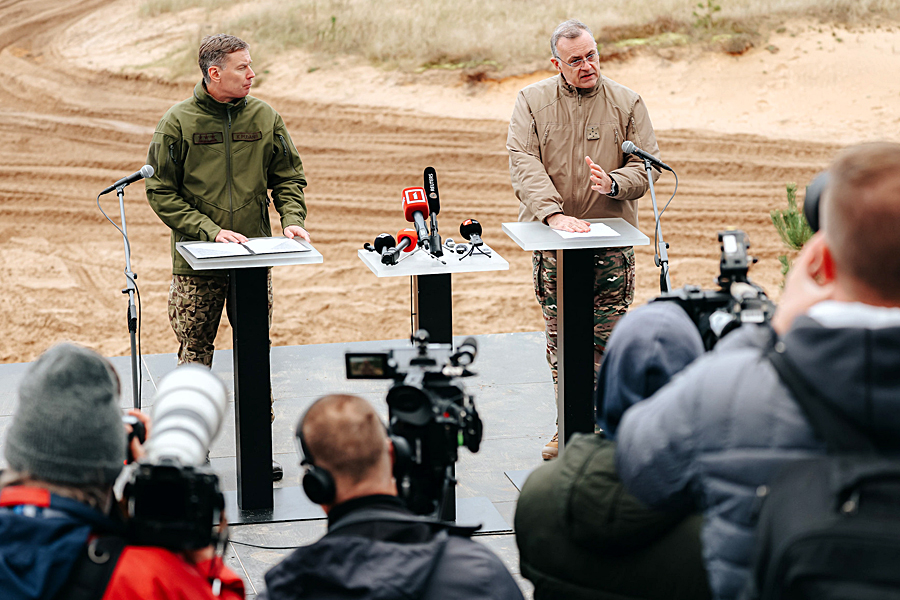
Digital Backbone eXperimentation 2026 (DiBaX 2026) took place in Latvia under the leadership of NATO Allied Command Transformation (ACT).
~
Press Release, Latvia, 31 October 2026: NATO’s Digital Backbone eXperimentation 2026 (DiBaX 2026) took place in Latvia from October 19-30, under the leadership of NATO Allied Command Transformation (ACT), supported by the Latvian Ministry of Defence and the National Armed Forces, with LMT Defence as the technical integrator.
This year’s communication experimentation focused on three use case areas: rapid deployment through 5G network slicing, resilient communications with failover between different communication methods, and passive object detection using 5G infrastructure. The aim was to test how different technologies, networks and systems could be integrated to strengthen NATO’s operational capabilities. The chosen use cases were designed to prepare for scenarios that don’t yet meet the Article 5 threshold, but still test NATO and its partners. Grey-zone incidents include drone intrusions and undersea cable incidents in the Baltic Sea.
“NATO’s DiBaX is utilising different innovative solutions from start ups to large enterprises all across the alliance, building on great diversity to improve resilience.
“We are ready to solve today’s problems and move on to tomorrow’s challenges.” Lukas Mueller, Acting Director DiBaX 2026

Preparing For Tomorrow’s Problems: DiBaX 2026 focused on three use case areas. The first explored how NATO forces could achieve secure command and control and data services from day one, before full infrastructure arrived. The experiment focused on how a private 5G network slice could be established on host-nation mobile infrastructure and used to rapidly and securely serve NATO forces.
Another use case area focused on resilience, exploring multiple communication paths and failover options in jammed environments. This includes radio failover across frequencies, satellite communications – including 5G direct-to-device – and troposcatter links.
The third use case area focused on data aggregation and sense-making, e.g. via passive object detection through 5G, especially in urban environments with dense tower coverage. The experiment explored 5G as a means to detect objects moving through its coverage area.
“The fact that the DiBaX experiment is taking place in Latvia for the fifth consecutive year demonstrates our ability to provide an environment for testing and refining the latest defence technologies under various conditions. This experience allows us not only to test innovative digital solutions in an environment that closely resembles realistic operational conditions, but also to strengthen cooperation with NATO Allies and promote technological interoperability,” emphasised Latvia’s Minister of Defence Raivis Melnis.

One of the high-level goals of DiBaX 2026 was to move from pure innovation to adoption. Rather than showcasing technologies, the experimentation focused on how to adopt and integrate these capabilities into military and civilian structures, including dual-use applications.
Countries such as Latvia, Lithuania, Germany, the United States, Canada, Finland and others took part in DiBaX 2026. NATO entities such as the NATO Defence Innovation Accelerator for the North Atlantic (DIANA), NATO Communications and Information Agency (NCIA), NATO CIS Group (NCISG), and other NATO Command Structure (NCS) entities were involved as well. Participants also included more than 60 technology partners, including Ascent Lumina, BPNE, Dronetag, Ericsson, FireSwarm Solutions, FortAegis, Inovec, Kelluu, Kinnami, the NATO Cooperative Cyber Defence Centre of Excellence (CCDCOE), Nokia, PLATH, Spectra Group, Tactiql, TEKEVER, Thales and others. LMT served as the technical integrator for the event.
“Communications have become the invisible battlefield of modern defence. The ability to protect the flow of information can determine how quickly forces understand what is happening and act accordingly. DiBaX is not just about testing individual technologies, but about ensuring that the digital backbone connecting them remains resilient in contested conditions. As the technology integrator for DiBaX 2026, LMT’s role is to enable different technologies to communicate with each other even under disrupted conditions.” Ingmārs Pūķis, Vice President and Member of the Management Board at LMT
Two Additional Experimentation Areas Built On DiBaX: Alongside the DiBaX digital backbone use cases, two additional NATO experimentation efforts took place: the Layered Counter-UAS Initiative (LCI-X) and Next Generation Targeting (NGT).
LCI-X, a NATO ACT Beacon Project focused on counter-UAS capabilities, examined how different sensors and effectors could work together as a layered defence against active unmanned aerial system threats. Meanwhile, NGT focused on accelerating the information-to-decision process. It explored AI-enabled decision support and data aggregation to help prepare data so that the right decisions could be made as quickly as possible.
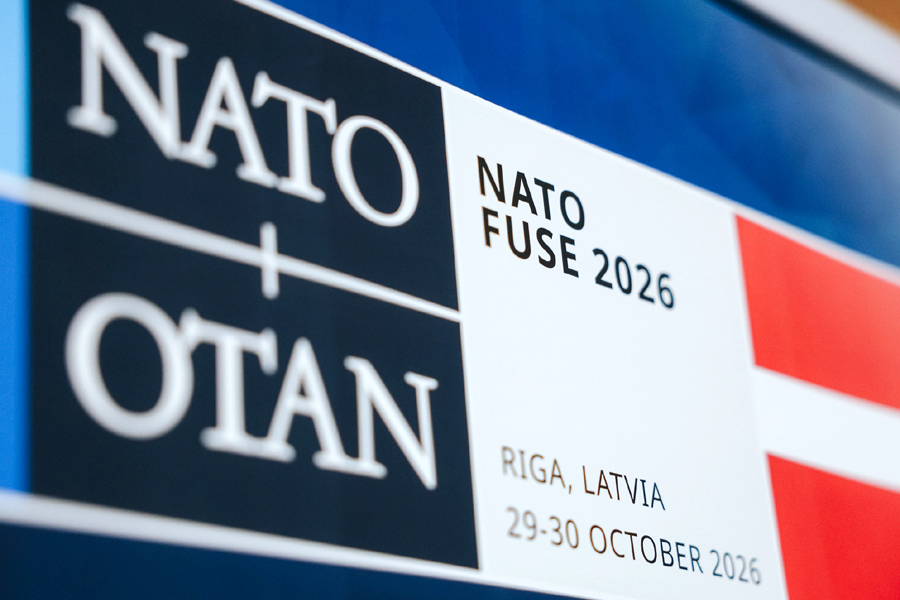
DiBaX 2026 culminated in late October, with early observer opportunities on 27–28 October, followed by NATO FUSE on 29–30 October. The first day of NATO FUSE featured plenaries, panels, and industry engagement, while 30 October focused on live field experimentation and outdoor demonstrations. DiBaX 2026 also included high-level NATO and EU engagement in Latvia. On 30 October, NATO Supreme Allied Commander Europe (SACEUR), General Alexus G. Grynkewich, visited Latvia and met with Latvian President Edgars Rinkēvičs. European Commissioner Valdis Dombrovskis also participated in NATO FUSE, where he announced the establishment of two pilot European Drone Technology Hubs in 2027, one in Latvia and one in the Netherlands. The hubs will accelerate the development, testing and deployment of drone and counter-drone technologies in close cooperation with NATO.
About DiBaX: The Digital Backbone eXperimentation (DiBaX) is a pioneering NATO experiment aimed at enhancing interoperability across domains through cutting-edge 5G and satellite communication technologies. The project reflects NATO’s commitment to strengthening defence capabilities in an interconnected world.
~