Thales is significantly accelerating production across its key Defence programmes addressing, among others, seven major domains.
~
Press Release, Paris, 08 July 2026: Thales is significantly accelerating production across its key Defence programmes. Over the 2024-2026 period, the Group’s capital expenditure will increase by over 40%, reaching around €830-850 million in 2026. These investments address, among others, seven major domains in the fields of Air Surveillance, Air Defence, Effectors, Sonars & Military communications.
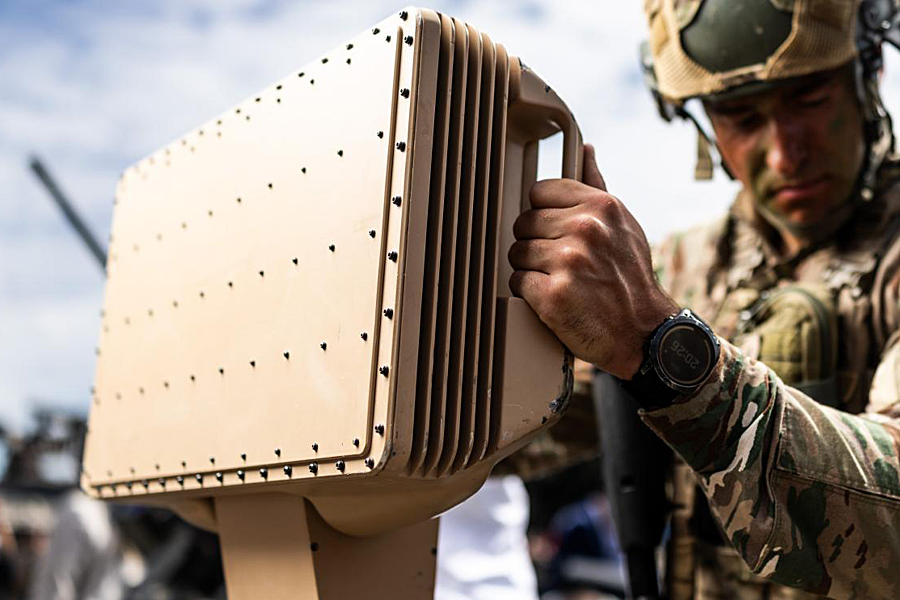
1. Ground Master and Ground Surveillance radars ramping up in France, the Netherlands and Germany: Thales’ Ground Master (GM) radar family continues to see strong international traction, with over 285 radars sold in more than 35 countries. To meet this demand, Thales is expanding its air surveillance and air defence production capacity, notably through the ramp-up of its defence radar output in France and the Netherlands, which has been multiplied by four between 2021 and 2025. In support of this expansion, Thales signed in June 2026 a strategic partnership with the Ministry of Defence in the Netherlands to expand radar production and test capacity in Hengelo, enabling an increase of antenna production by an additional 60% between 2025 and 2028. In Germany, Thales is also multiplying by five production capacity of its Ground Observer 12 (GO12) radars by end-2026, following an order, also in June, by the Federal Office of Bundeswehr Equipment, Information Technology and In-Service Support (BAAINBw) for 60 GO12 short-range battlefield radar systems, a portable reconnaissance and artillery radar able to detect drones and vehicles at 360°, developed in Germany and manufactured in Ditzingen (Baden-Württemberg), and already in service in 20 countries.
2. Laser Guided Rockets – industrial ramp-up in Herstal, Belgium: At its Herstal site in Belgium, Thales has launched an investment programme to significantly increase production capacity for both unguided rockets and 70 mm guided munitions. Output of Laser Guided Rockets (LGR) is set to increase five-fold between 2024 and 2026, followed by a further three-fold increase between 2026 and 2028. This ramp-up is supported by the vertical integration of critical manufacturing activities, accelerated recruitment, and increased local sourcing. Its initial phase benefited from EU funding under the ASAP programme.
3. Munitions production quadrupling at La Ferté-Saint-Aubin, France: At La Ferté-Saint-Aubin, Thales aims to quadruple production between 2023 and 2026. This ramp-up is backed by a significant investment to modernise the site, benefiting from a state-of-the-art automated foundry. The site relies on a network of more than 400 suppliers across France, representing an annual commitment of more than €120 million.
4. SAMP/T Air Defence system – Thales scaling up its share of production five-fold: As part of the SAMP/T NG NATO mission proven air defence system, for which Thales supplies key components, the Group is targeting a two-fold increase in production, in order to meet accelerating demand from European armed forces. The French variant of the system includes a Thales Ground Fire radar, which offers unmatched performance: a range of up to 400 km and panoramic coverage at 360° and 90° elevation. Thales also acts as the integrator of the fire control system (the command, control and fire control system: the ME-NG – Next Generation Engagement Module), developed in partnership with MBDA. SAMP/T NG is at the core of SkyDefender, the multi-layer, multi-domain Integrated Air and Missile Defence system launched by Thales this year. Built on an open, modular architecture, SkyDefender integrates easily with existing defences and can be further developed as threats evolve.
5. LMM – production ramp-up underway in Belfast, United Kingdom: LMM (Lightweight Multi-role Missile) production in Belfast increased fourfold between 2022 and 2025, reflecting a significant ramp-up in manufacturing capacity and output, with further plans to support a seven-fold increase in missile production within 4 years.
6. Naval systems – increased production and development in underwater warfare: CAPTAS naval sonar production in France increased 2.5-fold between 2024 and 2025, reflecting a significant increase in manufacturing capacity to meet growing naval defence requirements for anti-submarine warfare. In mine countermeasure warfare, Thales is launching new, more agile solutions with shorter delivery times: the delivery lead time for its mine countermeasure sonar has been halved, from 20 months to 10 months. With the project to acquire Exail Technologies, Thales aims to increase its scale in the underwater warfare market, and to expand its capabilities in inertial navigation systems through the addition of Exail’s complementary expertise.
7. Military communications – accelerating transformation across European sites: In June 2025, Thales inaugurated its new worldwide Centre of Excellence in Radiocommunications and a state-of-the-art logistics hub in Cholet (France), long known for its leading role in military communications, from the PR4G radio, sold in over 800,000 units in 50 countries, to today’s SYNAPS software-defined radio, alongside a fourfold increase in Eclipse jamming equipment output. By 2030, a significant investment plan will consolidate Thales’ French secure communications activities, covering radio, cryptography, satcom, deployable networks and electronic warfare. In Tubize, Belgium, the site is being extended, alongside a new land systems joint venture with JCD and FN Herstal and a land vehicle conversion centre. In the Netherlands, SOTAS vehicle communication production has tripled since end-2023, with a new Amsterdam site supporting further growth. Radio production is ready to scale up by 30 to 50%. Illustrating this agility, Thales delivered 205 civil-military hybridisation kits in around one year for France and other NATO countries, and is expanding its Romania competence centre for C4I, Cloud and network infrastructure to up to 100 people by end-2026.
Pascale Sourisse, Senior Executive Vice-President, International Development, Thales, said: ‘’Defence readiness starts with industrial readiness. Through our multi-domestic footprint in more than 20 European countries and steady investments in advanced technologies, industrial capacity, engineering talent and strategic cooperation between national champions, Thales is resolutely committed to serving the continent’s needs for interoperable and sovereign solutions, and to rapidly scaling up the EDTIB to support nations with trusted capabilities that underpin multi-domain operations.”
In support of this ramp-up the Group is recruiting more than 9,000 employees worldwide in 2026, including 70% in European countries. Over the past 5 years, Thales has recruited at least 8,000 people per year to support the growth dynamics of its core business sectors.
The Group has a long-standing tradition of partnerships across borders:
- Thales is an active player in transnational defence programmes including the SAMP/T NG, Scorpion/CAMO and MMCM programmes;
- The Group is invested in multiple joint ventures, including three in Italy with Leonardo (Thales Alenia Space, Telespazio and Elettronica); three main with Diehl Aviation (in avionics) and Junghans Microtech (fuse solutions) and with Airbus (UMS, semiconductors); SAES with Navantia in Spain; as well as LS2 with John Cockerill and FN Herstal in Belgium;
- Thales is also teaming up through numerous strategic partnerships: Poland (PGZ Group, Radmor), Norway (Kongsberg), Denmark (Terma) and Sweden (Saab), to name a few.
- In the domain of trusted cloud environments, we have created a joint venture with Google Cloud in France (S3NS) and are about to establish a second one in Germany.
~